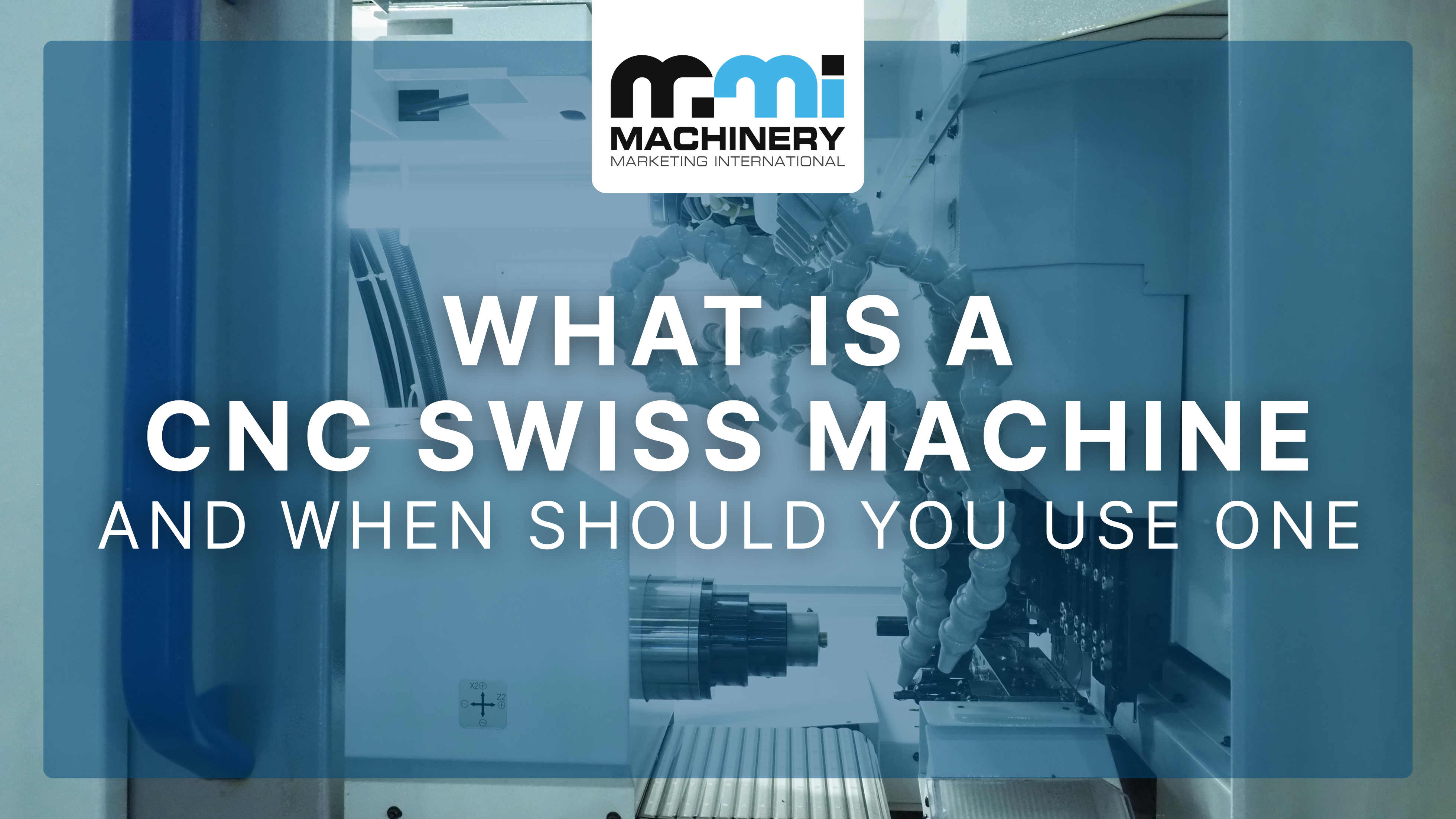
If you’re machining small, tight-tolerance parts, a CNC Swiss machine (also called a Swiss screw machine) is often the best tool for the job.
Swiss machines aren’t just another type of lathe, they’re built specifically for precision, efficiency, and high-volume production of small-diameter components. Here’s why shops rely on them, and how they compare to traditional CNC lathes.
1. Built for Small, Tight-Tolerance Parts
CNC Swiss machines excel at producing parts with:
- Small diameters
- Long lengths
- Tight concentricity requirements
- High precision tolerances
Because of how the material is supported (more on that below), Swiss machines minimize deflection and maintain accuracy, even on demanding geometries.
Industries like medical, aerospace, defense, firearms, electronics, automotive, and hydraulic systems depend heavily on Swiss machining for this reason.
2. Perfect for Long, Skinny Parts
One of the defining features of a Swiss machine is the guide bushing.
Unlike a traditional CNC lathe where the material is clamped at the spindle and extends outward, a Swiss machine supports the bar stock right at the point of cutting. This drastically reduces vibration and chatter.
The result?
You can machine long, slender parts with high length-to-diameter ratios that would normally flex or struggle on a standard lathe.
3. Faster Cycle Times
Modern CNC Swiss machines are designed for production efficiency.
Many are equipped with:
- Sub-spindles
- Live tooling
- Multiple tool stations
- Simultaneous cutting capabilities
Because the bar feeds through the machine while cutting, and multiple tools can work at once, cycle times are often significantly shorter than on conventional CNC lathes.
For shops running production, that means higher output and improved margins.
4. Complete Parts in One Setup
A major advantage of Swiss machining is the ability to complete complex parts in a single cycle.
A CNC Swiss machine can often perform:
- Turning
- Milling
- Cross drilling
- Tapping
- Cutoff
- Backworking (via sub-spindle)
Instead of moving a part between multiple machines, you can finish it complete in one setup. That reduces handling, improves accuracy, and eliminates stack-up error.
5. Ideal for High-Volume Production
Swiss machines are built to run.
They are commonly used in environments where:
- Lights-out machining is required
- Thousands (or millions) of parts are produced
- Consistency and repeatability are critical
For medium to high-volume jobs, Swiss machines deliver predictable performance and reliable output.
6. Superior Surface Finish
Because the workpiece is supported close to the cutting tool, vibration is minimized. This stability often results in:
- Cleaner finishes
- Better dimensional control
- Fewer secondary finishing operations
For precision industries, that finish quality can be a major advantage.
CNC Swiss vs. CNC Lathe: Which One Is Right?
CNC Swiss |
CNC Lathe |
|
Best when:
|
Best when:
|
|
Why it wins:
|
Why it wins:
|
Buying or Selling a CNC Swiss Machine?
Swiss machines are high-demand assets in the secondary market, especially brands like Citizen, Star, Tsugami, Tornos, and Hanwha.
Whether you're:
- Looking to sell surplus Swiss machines
- Evaluating equipment for liquidation
- Expanding your Swiss capacity
- Closing a facility or restructuring
- Seeking a formal machinery appraisal
MMI specializes in buying, selling, and valuing CNC Swiss equipment.
If you’re considering selling a CNC Swiss machine or acquiring one, contact MMI to discuss current market demand and pricing.

.png)